

NVIDIA has become one of the most influential technology companies in the world, powering everything from gaming and AI to robotics, cloud computing and autonomous vehicles. Its products shape industries, accelerate breakthroughs and redefine what is possible with modern computing.
Key Points
- NVIDIA is a leader in GPU, AI and accelerated computing technologies.
- Its products span gaming, data centers, autonomous driving, robotics, simulation, networking and creative workflows.
- Major product families include GeForce, RTX, Quadro, Tesla, DGX, Jetson, DRIVE and Omniverse.
- NVIDIA is shaping emerging fields such as generative AI, physical AI and large-scale simulation.
- Strengths include performance, software ecosystem and AI leadership.
- Challenges include high cost, supply constraints and competition in AI silicon.
Introduction to the World of NVIDIA Products
NVIDIA began as a graphics chip company, but today it stands at the center of AI computing. Its products power global research institutions, cloud providers, major gaming studios, robotics developers and enterprise data centers. What sets NVIDIA apart is its combination of hardware and software, designed to accelerate computing beyond the limits of traditional CPUs.
GeForce GPUs for Gaming
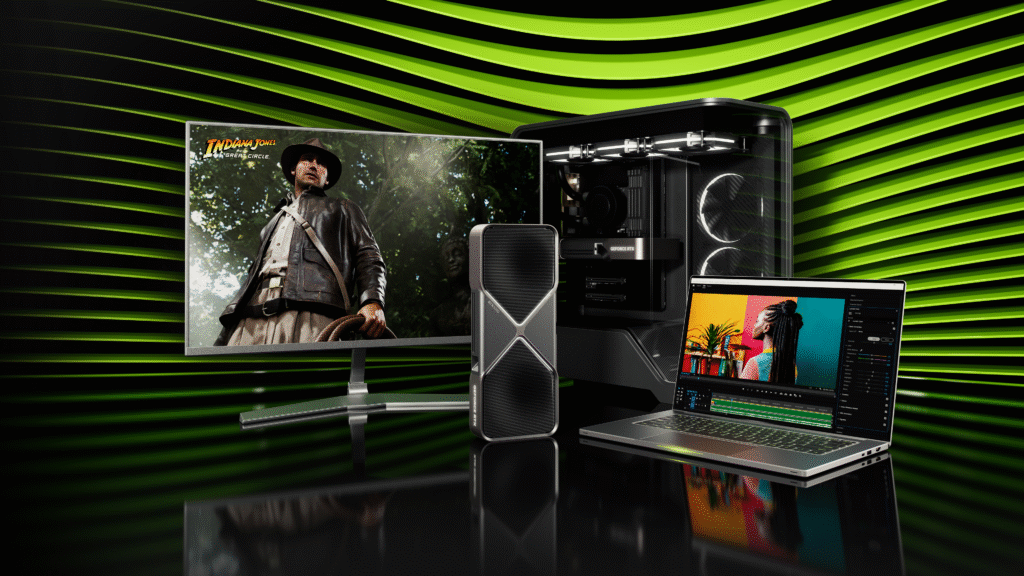
The GeForce series is one of the most recognizable product lines from NVIDIA. These graphics cards are engineered for gamers, creators and PC enthusiasts.
Key features include
- Real time ray tracing for lifelike lighting
- AI powered DLSS for performance boosts
- High frame rate gaming experiences
- Enhanced cooling and energy efficiency
GeForce RTX GPUs dominate the gaming industry, delivering performance that allows players to enjoy 4K and even 8K gaming on advanced displays.
NVIDIA RTX and Creative Workflows
Content creators rely heavily on the RTX platform from NVIDIA. This includes professional grade graphics cards used for filmmaking, architectural visualization, 3D design and VFX.
Benefits of NVIDIA RTX include
- Advanced rendering capabilities
- AI accelerated denoising and scaling
- Real time 3D editing
- Optimized drivers for Adobe, Autodesk and Unreal Engine
Professionals experience faster workflow cycles and improved visual accuracy with these cards.
Professional Visualization With NVIDIA Quadro
The Quadro lineup, now branded under RTX professional cards, is designed specifically for engineers and designers working on mission critical applications.
This range from NVIDIA supports:
- CAD and CAM workflows
- Medical imaging
- Scientific visualization
- Large scale simulations
Quadro GPUs are built for stability, reliability and extended runtimes, making them essential for enterprise environments.

Data Center Acceleration Using NVIDIA Tesla and A100 Series
The Tesla line, later succeeded by A100 and H100 class GPUs, forms the backbone of AI and HPC computing. These are some of the most powerful chips ever developed by NVIDIA.
They are used for:
- Deep learning training
- High performance computing
- Large language model scaling
- Cloud GPUs in AWS, Azure and Google Cloud
The performance of these GPUs has enabled breakthroughs in generative AI and scientific research.
NVIDIA DGX Systems
DGX systems from NVIDIA are complete AI supercomputers built for enterprise AI development. They combine multiple top tier GPUs with optimized software stacks.
DGX capabilities include
- Training trillion parameter models
- Multi GPU scaling
- Turnkey AI infrastructure for enterprises
- NVIDIA AI Enterprise software integration
AI first organizations rely on DGX stations and superpods to build and deploy advanced neural networks.
AI at the Edge With NVIDIA Jetson
The Jetson lineup is one of the most versatile edge AI platforms offered by NVIDIA. These small yet powerful modules are used in robotics, drones, surveillance systems and embedded computing.
Jetson modules offer
- Compact design with high AI performance
- Compatibility with the NVIDIA CUDA toolkit
- Real time processing for robotics and automation
- Efficient power consumption
Jetson is a key driver of physical AI innovation.

NVIDIA DRIVE for Autonomous Vehicles
The automotive products from NVIDIA fall under the DRIVE platform. It provides hardware and software needed to build self driving cars and intelligent cockpit systems.
It enables:
- Autonomous navigation
- Sensor fusion and real time mapping
- In car AI assistants
- Advanced driver assistance systems
DRIVE powers the future of transportation with safe and scalable automation technologies.
Simulation and Collaboration With NVIDIA Omniverse
Omniverse from NVIDIA is a groundbreaking platform for building digital twins, virtual worlds and simulation environments.
Omniverse supports:
- Photorealistic simulations
- Industrial digital twins
- AI trained robots
- Real time collaboration for teams
Companies use Omniverse to simulate factories, cities and complex workflows before building them in the real world.
Networking With NVIDIA Mellanox
Mellanox, acquired by NVIDIA, provides high speed networking solutions essential for AI clusters and data centers.
These solutions deliver:
- High bandwidth connectivity
- Low latency communication
- Scalability for supercomputing
- Improved AI training speeds
Networking is a crucial component of multi GPU systems and cloud infrastructure.

Software Innovations Across NVIDIA Products
Beyond hardware, NVIDIA leads in AI and graphics software. Their platforms such as CUDA, cuDNN and TensorRT are essential tools used by researchers and developers worldwide.
Key software advantages
- Highly optimized AI frameworks
- Deep learning performance boosts
- Large developer ecosystem
- Cross platform compatibility
Software is what binds the entire ecosystem together and maximizes hardware performance.
Pros and Cons of NVIDIA Products
Pros
- Wide ecosystem across gaming, AI, robotics and enterprise
- Industry leading performance in GPUs
- Strong software stack
- Robust support for developers and creators
- Proven reliability in mission critical operations
Cons
- High cost of flagship GPUs
- Availability issues during peak demand
- Strong competition in AI chips from rivals
- Some products require advanced technical expertise
Conclusion
From gaming to AI supercomputers, NVIDIA has built an unmatched product ecosystem that continues to push technology forward. Whether powering autonomous robots, transforming scientific research or enabling immersive gaming, the influence of NVIDIA is evident across industries. It remains one of the driving forces of innovation and the future of accelerated computing.